
Where Small Businesses Can Still Compete on Google’s Results Page: the AI Summary and the Map
Google's results page now opens with an AI answer, then the local map, then ads mixed in with the regular listings. Small businesses have the most room to compete in the AI summary's source cards and the map.
You don't have to outrank the biggest sites to be seen on Google. A page on your own site that answers a customer question clearly can earn a source card, and a complete Google Business Profile puts you in the running for the map. Both sit above the regular listings.
Google’s search results layout now runs in three parts: an AI answer at the top, the local map below it, and then paid ads mixed in with the regular listings. For a small business, the two places with the most room to compete are the AI summary and the map. The regular listings are getting harder.
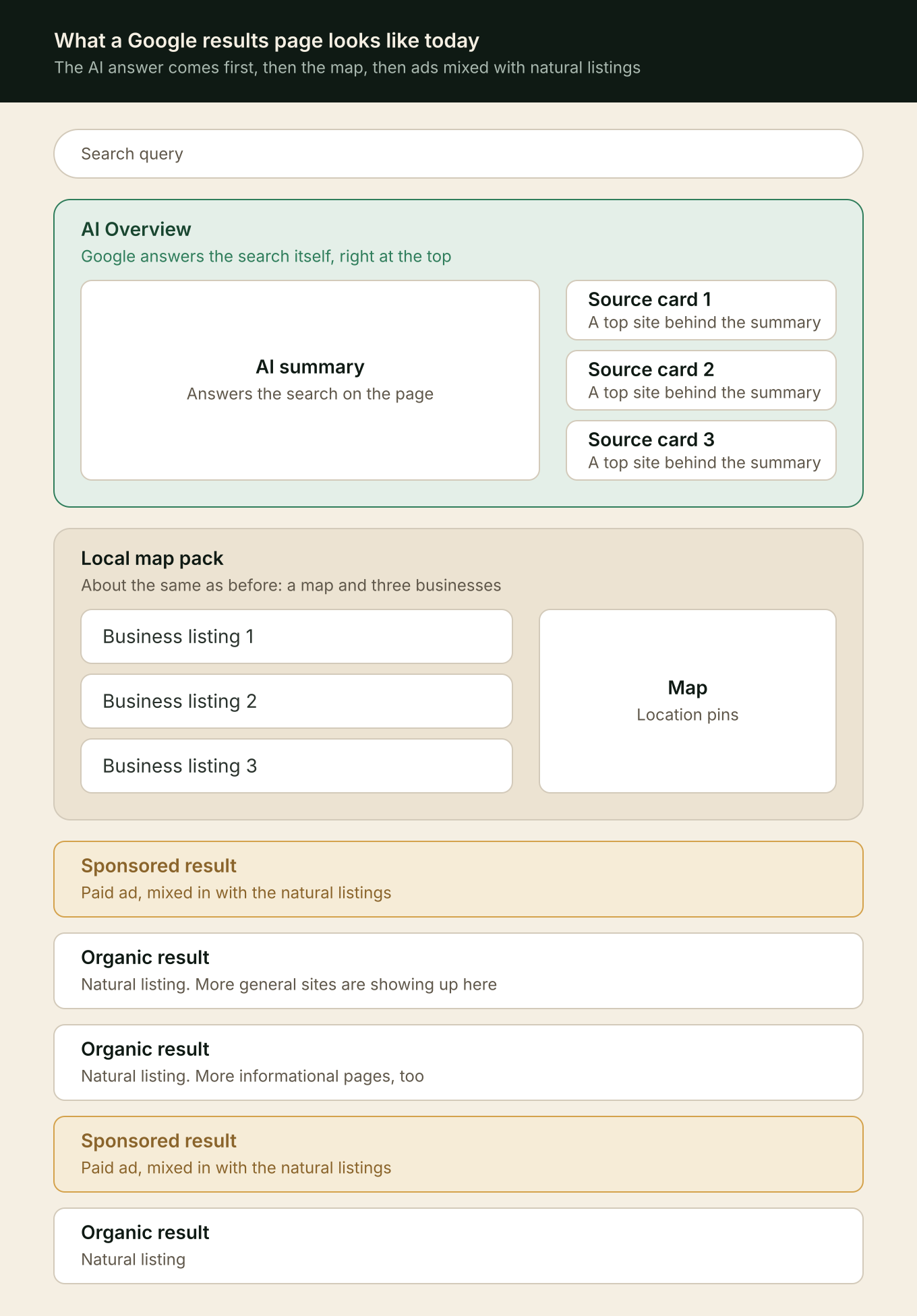
What each part does
- AI Overview. Google writes its own answer to the search, so many people get what they need without clicking anything. Next to the summary sit three source cards: links to sites the answer drew on.
- Local map. About the same as it has been: a map and three nearby businesses, pulled from Google Business Profiles.
- Ads and regular listings. Paid ads are mixed in with the natural (unpaid) listings. More of those natural spots are going to large general sites and informational pages.
What diib’s data shows
We compared September 2024 with September 2026 for 17,585 Google Business Profiles connected to diib. More people are seeing these profiles in Google Search, but fewer are clicking through to the website or calling.
| All 17,585 profiles combined | Sep 2024 | Sep 2026 | Change |
|---|---|---|---|
| Search impressions (times a profile was shown in Google Search) | 16.7M | 20.7M | +24% |
| Website clicks | 1.39M | 1.19M | -15% |
| Calls | 407K | 356K | -13% |
How we got the figures: we used the daily Google Business Profile numbers Google reports for every business that connected its profile to diib. We kept only profiles with at least 25 days of data in each of September 2024, September 2025 and September 2026, and counted each website once. That left 17,585 profiles. Search impressions are desktop plus mobile, added up for each September.
The timing fits a results page that answers more searches without a click. These numbers alone don’t prove the new layout caused the drop in clicks and calls.
Where a small business can compete
The source cards and the map are the two spots where a local or specialist business can sit next to much bigger names. Source cards tend to go to pages that answer the question clearly, and AI search builds local business recommendations mostly from websites. Google has also been putting more website links in its AI answers. The map is built from Google Business Profiles, so it tends to favor businesses close to the person searching.
The regular listings are a tougher fight. A small site is up against big general sites there, and that is where we see the least room.
The layout described here is what we see when we look at results pages, and it changes by search: some searches show no AI answer, and searches with no local angle show no map.
For more on the AI answer itself, read what the AI Overview is and whether it’s good or bad for your business.